
Meine Fahrten
Freight Invoice Not Paid - What Carriers Can Do (Including Escrow Explanation)

If a freight invoice remains unpaid, there is a typical process: First, check whether the invoice is formally correct and whether a payment deadline has already passed. Then follows the written payment reminder with a set deadline, followed by legal dunning procedures or referral to a collection agency. As a carrier, you also have a statutory lien on the goods you transport, but only as long as you possess them and only for claims arising from the respective contract. Once the goods are delivered, this leverage is gone.
Therefore, the more important part is before the order: Check creditworthiness, agree on payment terms in writing, document delivery, and work with partial prepayment or escrow payment processing for new customers. The latter option is the most effective because it prevents any open claims from arising. With MUVN Pro, this is exactly the standard: The amount is deposited before the start and paid out after delivery, and it is free for drivers.
When is a freight invoice due?
Before you send reminders, clarify the initial situation. Three points determine whether there is a payment delay at all.
Is a payment deadline agreed upon? In the transport industry, 30 to 60 days are common. If such a deadline is stated in the order or in the client's terms and conditions, the invoice is simply not due yet.
Is the invoice formally complete? Missing mandatory information is the most common excuse for delaying payment. Check the tax number or VAT identification number, invoice number, date of service, correct company name of the recipient, and the order or reference number.
Is there a complaint? If damage or delay is claimed, it can quickly lead to a counterclaim. Here, your documentation matters, not your memory.
What steps are there in case of payment delay?
| Step | What Happens | When Useful |
|---|---|---|
| Written Payment Reminder | Reminder with a specific deadline and mention of the invoice | Immediately after due date |
| Second Reminder with Announcement | Notice of further steps, late fees, and costs | After deadline expiration |
| Lawyer's Letter | Claim is asserted legally | For higher amounts or recognizable delay tactics |
| Legal Dunning Procedure | Simplified procedure through the dunning court | For undisputed claims |
| Collection | Referral to a collection agency | For multiple old cases or lack of own capacity |
| Lawsuit | Disputed procedure in court | When the claim is contested |
Which step is appropriate in each case depends on the amount, evidence situation, and limitation periods. Freight law claims are subject to shorter periods than general claims. This is a point where legal advice can quickly pay off.
What is the carrier's lien?
The Commercial Code grants the carrier a statutory lien on the goods they transport. It secures claims arising from the freight contract and exists only as long as you possess the goods or can dispose of a document regarding them.
Three things are important here. First: After delivery, the leverage is gone. Second: It secures claims from this contract, not any arbitrary old claims against the same customer. Third: Anyone who withholds the goods without legal grounds risks their own claims for damages.
Therefore, this topic does not belong in the category of "I'll do it spontaneously." If you are considering withholding goods, clarify this with a lawyer beforehand.
How can you prevent payment defaults from the outset?
Check creditworthiness before the first order. A commercial register extract, VAT identification number, and a brief business report cost little and prevent the most expensive cases.
Document payment terms in writing. Amount, due date, scope of services, waiting times, assistance, and additional services. Oral agreements are worthless in case of disputes.
Document delivery properly. Photos before loading and after delivery, signed delivery receipt, or digital confirmation with a timestamp. This documentation will decide if a complaint arises.
Work with partial prepayment for new customers. An upfront portion is standard in the industry and reliably filters out unreliable clients.
A client should never account for more than half of your revenue. Otherwise, a single default can be existentially threatening.
Be particularly cautious on open marketplaces. Free job boards like clickapoint, box24, or transportbranche do not vet their participants beforehand. That’s exactly why they are free, and that’s why the vetting is up to you.
What is escrow payment processing, and what does it bring you?
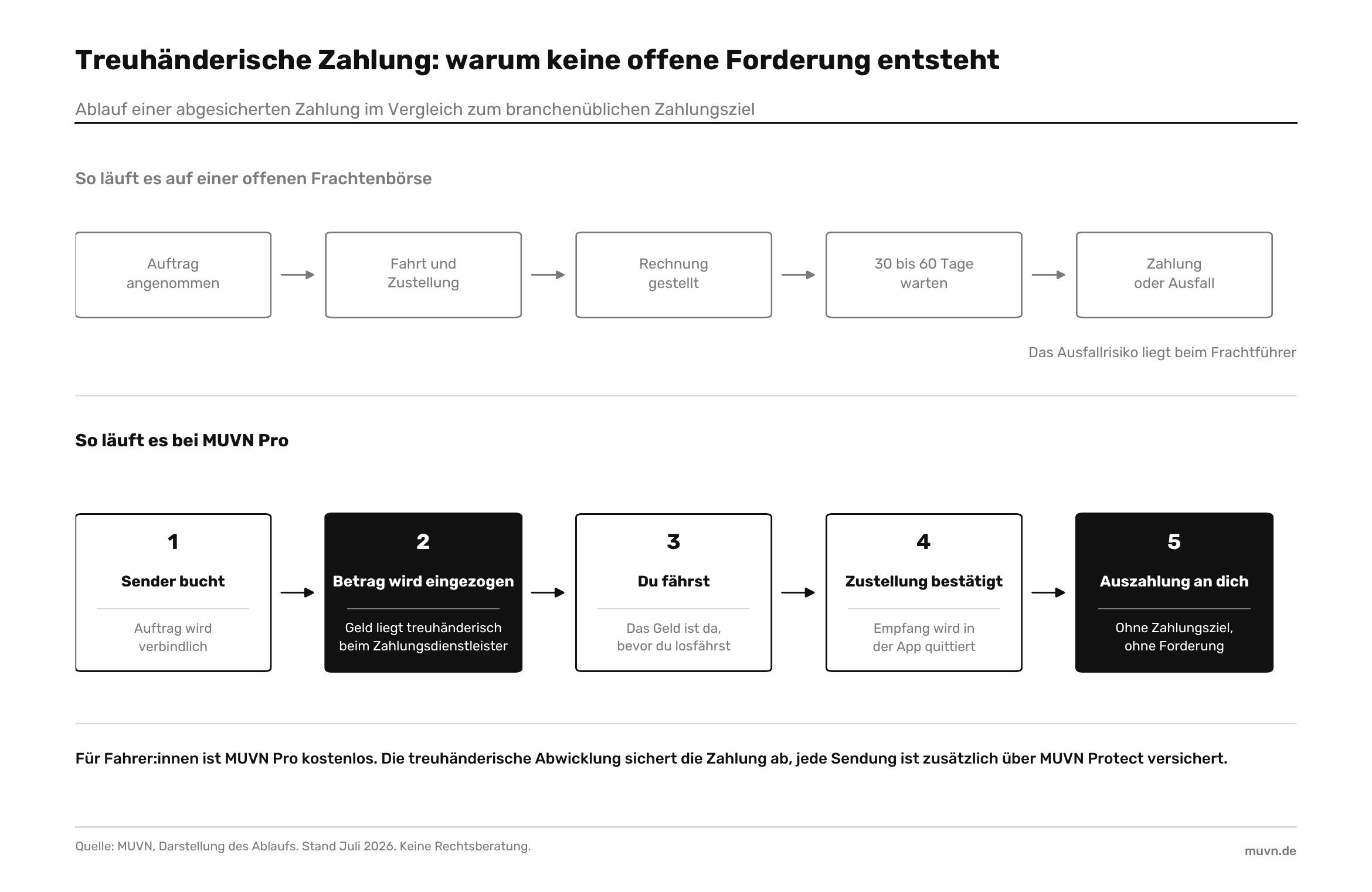
The most effective way to eliminate payment defaults is the one where no open claims arise at all. This is achieved through escrow payment processing, commonly referred to as escrow internationally.
Here’s how the principle works: A neutral party, usually a regulated payment service provider, steps in between the client and the contractor. The client pays the agreed amount not to you, but to this party, and this happens before the service is rendered. The money is held in escrow; at this moment, it belongs to neither them nor you. Only when delivery is confirmed is the amount released and paid out to you.
What this practically changes: You no longer operate on trust. Before you drive the first kilometer, the money is already available and reserved. There is no payment deadline you need to bridge, no open claim in your accounting, and no situation where a client is unreachable after delivery.
What it does not provide: An escrow arrangement does not replace transport insurance. It secures payment, not the goods. In the case of a legitimate complaint, there is also a clarification process before payment is made. This is the price for the system to work for both sides.
This principle is known from online commerce and is still little used in transport because the industry historically operates with payment deadlines. For small businesses, it is the biggest difference because a single default can consume the liquidity of an entire month.
With MUVN Pro, the payment is structured exactly this way. The amount is collected from the client at the time of booking and paid out to you after confirmed delivery. So you never operate on trust, no open claims arise, and payment defaults are structurally excluded.
For drivers, MUVN Pro is free. There are no base fees or commissions, neither monthly nor per order. Additionally, every shipment through MUVN Protect is covered by basic insurance, and higher coverage can be added per shipment.
This eliminates exactly the three cost blocks that hit small businesses the hardest: fixed costs in weak months, commissions on every order won, and claims defaults that are not accounted for but are still the most expensive.
Frequently Asked Questions
What can I do if a client does not pay the freight invoice?
First, check the due date and formal completeness of the invoice. Then follow up with a written payment reminder with a deadline, possibly a lawyer's letter, and subsequently the legal dunning procedure, collection, or a lawsuit. Which path fits depends on the amount and evidence situation.
Am I allowed to withhold the goods if payment is not made?
The Commercial Code grants the carrier a lien on the transported goods, securing claims from the freight contract. It exists only as long as you possess the goods. Whether it applies in individual cases should be checked legally, as unjustified withholding can trigger your own claims for damages.
What is an escrow payment in transport?
An escrow payment processing where a payment service provider collects the amount from the client before the service is rendered and pays it out to the carrier after confirmed delivery. No open claims and no payment deadlines arise.
How long can a payment deadline be in transport?
30 to 60 days are standard in the industry, but it depends on the specific agreement. For payment claims in business transactions, there are legal limits for excessively long payment periods. The evaluation of a specific contract belongs in legal review.
How can I best prevent payment defaults?
Check creditworthiness before the first order, document payment terms in writing, document delivery with photos and delivery receipts, work with partial prepayment for new customers, and distribute revenue across multiple clients. The safest option is an escrow arrangement where the amount is already deposited before the trip. With MUVN Pro, this is the standard, and it is free for drivers.
<aside> ⚖️Legal Notice: This article is for informational purposes only and does not constitute legal advice. It does not replace the examination of individual cases or consultation with a lawyer. Legal situations, deadlines, and procedures may change and depend on specific circumstances. For a binding assessment, please seek legal advice. MUVN assumes no liability for decisions made based on this article.
</aside>